
Georges Braque
Boccara artwork selection by Didier Marien
Works by Georges Braque in the Boccara Collection
ORIGINS & VISION
About the Artist
The Artisan’s Heritage and the Cubist Revolution
Georges Braque (1882–1963) was an artist who famously viewed himself as a craftsman first and a philosopher second. Born into a family of skilled decorative painters, he spent his youth learning the artisanal secrets of graining, marbling, and lettering—techniques that would later become the surprising “low-art” ingredients of high Cubism. While his peers often sought the spotlight, Braque was the quiet, methodical engine of the avant-garde. His partnership with Pablo Picasso was so intimate that the two were, in Braque’s words, “like two mountain climbers roped together.” This collaboration birthed Cubism, a movement that shattered traditional perspective and rebuilt it as a complex, multi-dimensional experience of form and space.
The Evolution of the Bird: From Ceiling to Loom
In the final decade of his life, Braque’s work moved away from the cluttered tables of still-life and toward the open, ethereal spaces of the sky. This period is defined by his signature bird motif—a stylized, soaring avatar of freedom and spiritual transcendence. The significance of this imagery was solidified when Braque was commissioned to paint the ceiling of the Salle Henri II at the Louvre in 1953. His depiction of massive, dark birds set against a deep blue field was the first time a living artist had been invited to contribute to the permanent architectural decoration of the palace. This visual shorthand, which combined the density of matter with the lightness of flight, became the crowning achievement of his mature style.
Pélias et Nélée: A Mythic Dialogue in Blue
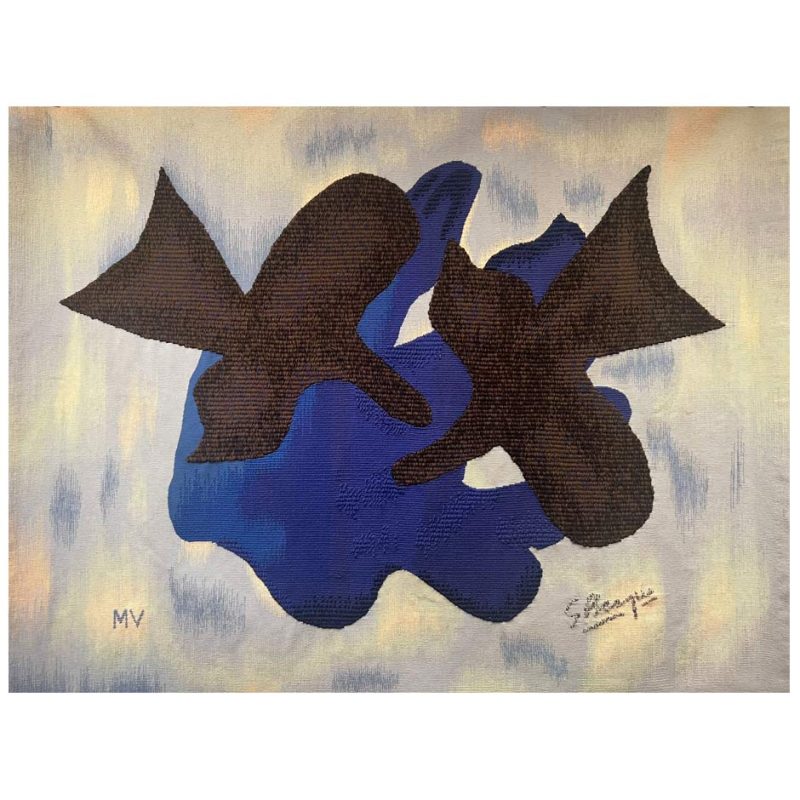
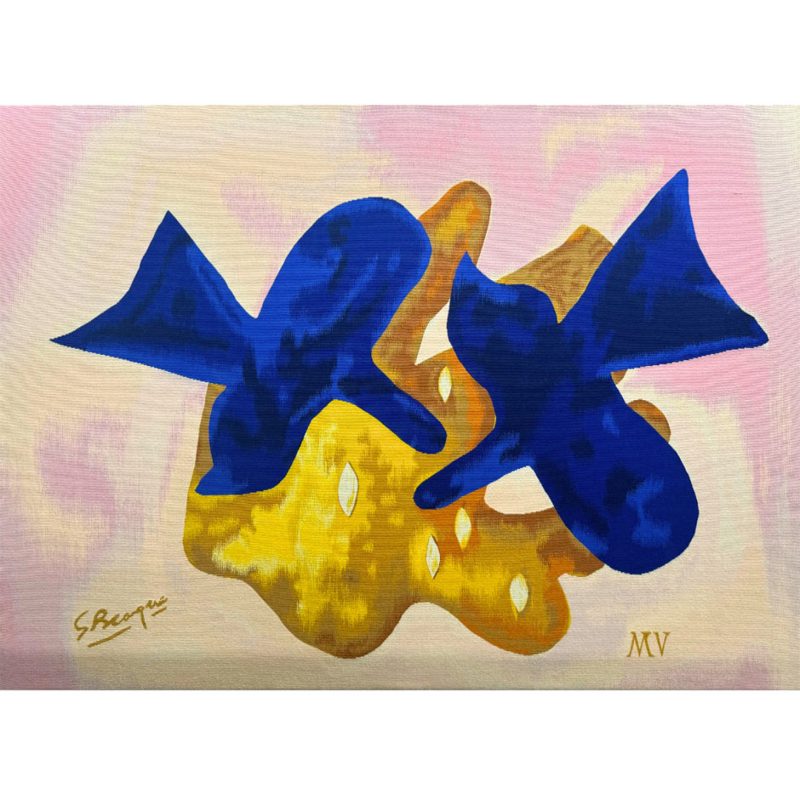
The singular motif of Pélias et Nélée stands as one of Braque’s most poetic explorations of movement and duality. Referencing the mythological sons of Poseidon, the work moves beyond a literal narrative to present two mirrored, winged silhouettes. These figures serve as celestial messengers, their forms carved out of a biomorphic field of deep blues and soft lavenders. Originally appearing as a gouache and later as a color lithograph shortly before his death in 1963, the design reflects Braque’s ability to find “visual silence” within a composition. In its textile form, the tactile rhythm of the woven wool enhances the sense of flight, making the mythic brothers feel both grounded in material and suspended in an eternal, blue atmosphere.
The Moulin de Vaudoboyen: A Heritage of French Weaving
The execution of Braque’s textile visions was entrusted to the Moulin de Vaudoboyen, a historic textile manufacturer nestled in the town of Bièvres. Dating back to the 18th century, this traditional mill represents the absolute pinnacle of French textile heritage. By utilizing the natural power of the nearby river to operate its machinery, the mill has spent centuries blending artisanal expertise with meticulous technical precision. This dedication to craft perfectly mirrored Braque’s own artistic philosophy. The resulting tapestries are not mere replicas of his paintings; they are autonomous art objects that honor the region’s industrial past while preserving the poetic, hand-crafted spirit that Georges Braque spent his entire life championing.