
Nadia Léger
Boccara artwork selection by Didier Marien
Works by Nadia Léger in the Boccara Collection
ORIGINS & VISION
About the Artist
From the Russian Avant-Garde to the Heart of Paris
Nadia Khodossievitch-Léger (1904–1982) was born into the rural landscapes of Belarus, yet her artistic trajectory was anything but provincial. Her journey into modernism began at its very source: the studio of Kazimir Malevich in Smolensk. Under the father of Suprematism, she learned to see the world as a configuration of “pure feeling” expressed through geometric form and color. This foundational training stayed with her even as she moved to the Warsaw Academy and eventually to Paris in 1925. In the French capital, she found a home at the Académie Moderne, where her restless creative spirit allowed her to bridge the gap between the spiritual geometry of the East and the industrial, mechanical aesthetics being championed by the Parisian circle.
A Master of the “Clash of Contrasts”
Nadia’s style is defined by what critics have termed a “clash of contrasts”—a dynamic interplay where abstraction and figuration are not opposites, but two sides of the same coin. During her decades as a key collaborator (and eventually wife) of Fernand Léger, she maintained a distinct pictorial identity that favored formal clarity and spiritual focus. She was a tireless innovator, co-founding the influential magazine L’Art contemporain and moving with ease between the rigors of Cubism and the grounded weight of Socialist Realism. Her ability to adapt her visual language to the intellectual currents of her time made her a central figure in progressive art circles, exhibiting alongside the likes of Picasso and Hans Hartung.
Formes Géométriques and the Textile Language
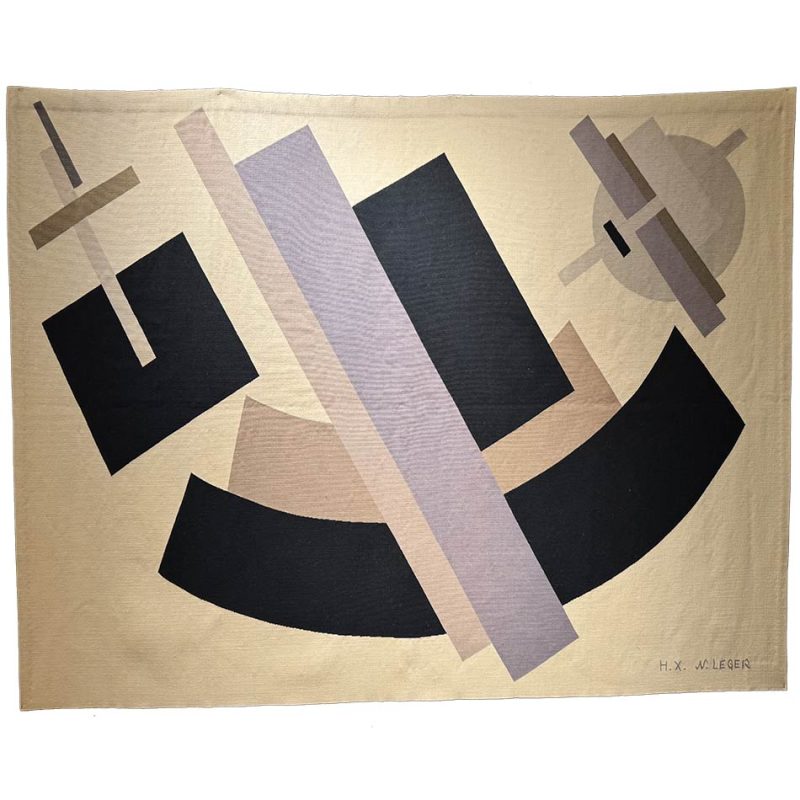
While Nadia Léger was a prolific painter and curator—notably establishing the Fernand Léger Museum in Biot—her fascination with new mediums naturally led her to the world of tapestry. In the 1960s, she began a significant collaboration with the workshops of Aubusson to translate her abstract compositions into large-scale wool works. For Nadia, the tapestry was the ultimate “modern mural,” a medium capable of humanizing the architectural space while maintaining the graphic intensity of the avant-garde. Her celebrated work, Formes géométriques, is a definitive example of this transition, where the spiritual clarity of her Suprematist roots is granted a tactile depth and structural permanence.
A Legacy of Preserving and Innovating
Nadia Léger’s textile works are more than mere reproductions; they are an extension of her lifelong dialogue with the major artistic movements of the century. By working closely with the master weavers, she ensured that the vibrant reds, deep blacks, and precise geometric contours of her paintings were recreated with total fidelity to their original energy. At Boccara, these tapestries are celebrated as an apotheosis of the avant-garde spirit, representing the rare moment when the radical visions of the early 20th century were successfully integrated into the warmth and sophistication of the modern home. Her work remains a striking testament to a woman who navigated the complexities of exile and war to leave an indelible, woven mark on the history of modern art.